
More Information
Submitted: Sepember 10, 2026 | Accepted: Sepember 17, 2026 | Published: Sepember 18, 2026
Citation: Rosas-Peralta M, Palomo-Piñón S, Alcocer L, Galván-Oseguera H, Chávez-Mendoza A, Cardona-Muñoz E, et al. The Disease Burden and Economic Impact of Difficult-to-Control and Resistant Hypertension in Mexico: A Model-Based National Estimate of Direct and Indirect Costs and 5- and 20-Year Projections. Ann Clin Hypertens. 2026; 10(1): 40-51. Available from:
https://dx.doi.org/10.29328/journal.ach.1001044.
DOI: 10.29328/journal.ach.1001044
Copyright license: © 2026 Rosas-Peralta M, et al. This is an open access article distributed under the Creative Commons Attribution License, which permits unrestricted use, distribution, and reproduction in any medium, provided the original work is properly cited.
Keywords: Resistant hypertension; Difficult-to-control hypertension; Mexico; Economic burden; Hospitalization; Cardiovascular disease; Chronic kidney disease; Cost of illness; Health economics; Hypertension

The Disease Burden and Economic Impact of Difficult-to-Control and Resistant Hypertension in Mexico: A Model-Based National Estimate of Direct and Indirect Costs and 5- and 20-Year Projections
Martin Rosas-Peralta* Silvia Palomo-Piñón, Luis Alcocer, Héctor Galván-Oseguera, Adolfo Chávez-Mendoza, Ernesto Cardona-Muñoz, Humberto Álvarez-López, J Manuel Enciso-Muñoz, Enrique Díaz-Díaz and GREHTA Group
Group of Experts in Hypertension, México
*Corresponding author: Martin Rosas-Peralta, MD, PhD, Group of Experts in Hypertension, México, Email: [email protected]
Background: Hypertension is the leading modifiable risk factor for cardiovascular, cerebrovascular, and kidney disease. In Mexico, 29.1% of adults have hypertension, while only 60.1% of pharmacologically treated individuals achieve blood-pressure control. Difficult-to-control hypertension and true resistant hypertension (RH) represent high-risk phenotypes associated with greater cardiovascular, renal, and healthcare burden.
Methods: A prevalence-based cost-of-illness model was developed from the Mexican healthcare-system perspective, with a secondary societal perspective. ENSANUT 2021–2024 data were combined with international estimates of apparent treatment-resistant hypertension (aTRH) and true resistant hypertension (RH). Direct hospitalization costs were estimated using official 2026 Instituto Mexicano del Seguro Social (IMSS) unit costs. For long-term projections, the aggregate planning model was strengthened by indexing the exposed adult population to annual CONAPO demographic projections, explicitly considering all-cause mortality as a competing risk and cardiovascular mortality as a component of that mortality burden. To estimate costs attributable specifically to RH, a counterfactual non-resistant-hypertension risk was derived from adjusted comparative hazard ratios, and only the excess event risk above that baseline was assigned to RH.
Results: Approximately 24.4 million adults have hypertension, 12.5 million receive pharmacological treatment, and 5.0 million remain uncontrolled in the original epidemiological cascade. An estimated 1.84 million have aTRH and 1.29 million have true RH. The total modeled hospitalization burden occurring among patients with true RH is approximately MXN $5.62 billion annually. After subtracting the counterfactual hospitalization burden expected in otherwise comparable patients with non-resistant hypertension, the incremental hospitalization cost attributable specifically to RH is approximately MXN $1.08 billion per year (MXN$835 per patient-year). Under 2%, 3%, and 4% annual sensitivity growth in event intensity/resource use, the corresponding 20-year cumulative RH-attributable direct-cost envelope is approximately MXN $26.2, $28.9, and $32.1 billion, respectively, before discounting.
Conclusion: Difficult-to-control and resistant hypertension represent a substantial clinical and economic burden in Mexico. Distinguishing the total hospitalization burden observed among patients with RH from the incremental burden attributable to treatment resistance materially reduces the risk of overestimation. Long-term estimates remain planning scenarios and should be interpreted in conjunction with demographic change, mortality, competing risks, and uncertainty in Mexican RH-specific event rates. These findings support systematic detection, out-of-office confirmation, optimized combination therapy, and development of a prospective national RH registry.
Hypertension is no longer appropriately conceptualized as an isolated elevation of blood pressure. It is a systemic disease and a central determinant of cardiovascular, renal, metabolic and neurological morbidity. Contemporary international guidance recognizes hypertension as a major contributor to coronary artery disease, heart failure, stroke, chronic kidney disease, atrial fibrillation and premature mortality [1-5]. The World Health Organization’s 2025 Global Report on Hypertension emphasizes that inadequate detection, treatment and control remain major global health-system failures and that improving hypertension control can reduce both mortality and healthcare expenditure [6].
Mexico represents a particularly important setting in which to examine this problem. The most recent ENSANUT 2021–2024 analysis, including 34,954 participants, estimated hypertension prevalence at 29.1% among adults. Of those with hypertension, 62.9% had previously been diagnosed, and among individuals receiving pharmacological treatment, only 60.1% had controlled blood pressure. The same analysis estimated that more than 1.1 million cardiovascular events could potentially be avoided over 10 years if blood pressure were normalized [7] (Figure 1).
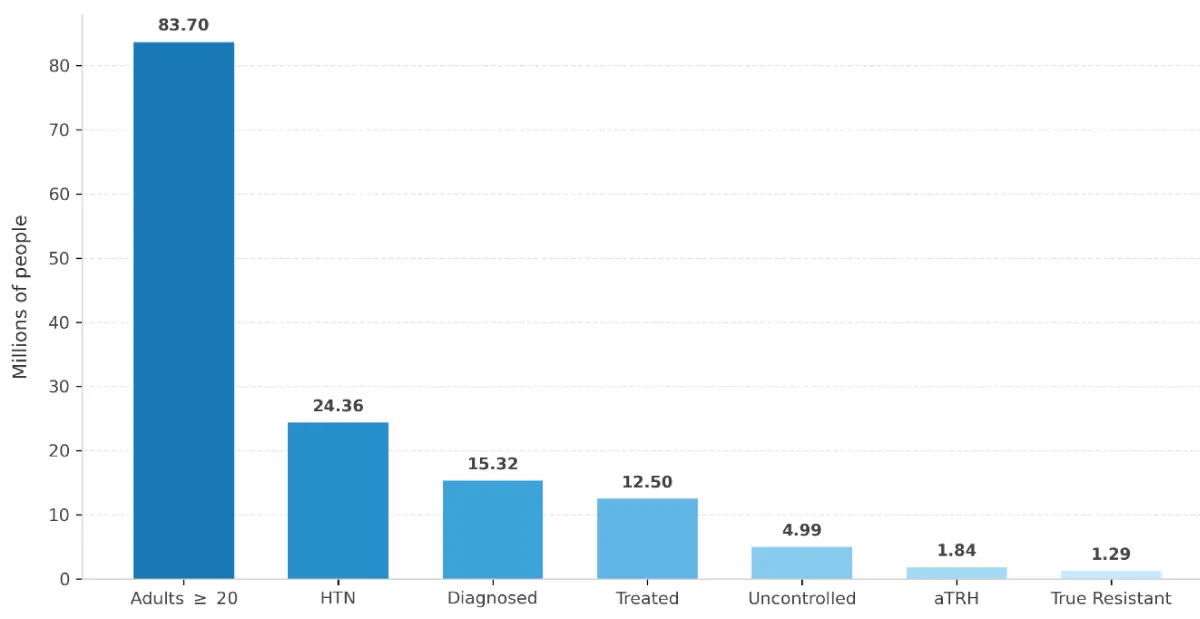
Figure 1: Epidemiological cascade of difficult-to-control and resistant hypertension in Mexico. The model demonstrates the transition from the total adult population to hypertension, diagnosis, treatment, uncontrolled hypertension, apparent treatment resistance and true resistant hypertension. Key message: approximately 5 million treated adults may remain uncontrolled, providing the population from which the smaller but high-risk resistant phenotype must be identified.
The 2026 Mexican Consensus on Arterial Hypertension developed by GREHTA introduces an explicitly cardio-reno-metabolic framework, emphasizing that hypertension should be evaluated within the MACARENHA phenotype and that treatment should prioritize accurate blood-pressure measurement, risk stratification, early combination therapy and sustained control [8]. The consensus defines resistant hypertension as uncontrolled blood pressure despite three or more appropriately selected antihypertensive agents, including a full-dose diuretic, after pseudoresistance has been excluded. It recommends single-pill combinations, optimization of a renin-angiotensin-system blocker plus calcium-channel blocker plus thiazide-like diuretic, followed by spironolactone when true resistance persists [8].
The problem becomes considerably more complex when treatment-resistant hypertension is considered. Current guidelines distinguish resistant hypertension from apparent treatment resistance and emphasize the need to exclude inaccurate blood-pressure measurement, nonadherence, white-coat effects, interfering drugs and secondary hypertension [2-5,9-11]. The 2025 AHA/ACC guideline estimates resistant hypertension in approximately 8.5–20% of treated hypertensive adults, depending on the population and definition, and states that patients with resistant hypertension have at least a 50% higher risk of myocardial infarction, stroke, end-stage kidney disease and cardiovascular death compared with hypertensive adults without treatment resistance [5].
This excess clinical risk inevitably translates into economic consequences. Stroke, myocardial infarction, heart failure and advanced kidney disease require emergency care, hospitalization, intensive care, rehabilitation and long-term pharmacological treatment. Moreover, premature mortality and disability generate substantial productivity losses. Mexico already has evidence of a considerable economic burden attributable to hypertension. Earlier cost-of-illness analyses estimated billions of US dollars in direct and indirect costs, while more recent Mexican analyses demonstrated substantial productivity losses associated with hypertension and cardiovascular disease [12-14]. However, these studies largely address hypertension as a whole rather than the particularly high-risk subgroup of patients with difficult-to-control or resistant hypertension.
The objective of this study was therefore to construct a transparent national model of the epidemiological and economic burden of difficult-to-control and resistant hypertension in Mexico, using current epidemiological information, contemporary definitions, official 2026 IMSS healthcare costs and established health-economic methodology.
Study design
We performed a prevalence-based, model-based cost-of-illness analysis from two perspectives:
- Healthcare-system perspective: direct hospitalization costs.
- Societal perspective: direct hospitalization costs plus an estimated indirect-cost envelope incorporating productivity losses and other societal consequences.
The analysis is intended as a national planning model rather than a claim of observed national expenditure.
The methodology follows internationally accepted principles for health-economic evaluation and reporting [15-17]. Mexican economic-evaluation guidance was also considered [18].
All monetary estimates are expressed in 2026 Mexican pesos (MXN).
Epidemiological inputs
For the 2026 cross-sectional national cascade, the original model retained an adult population denominator of approximately 83.7 million in order to preserve comparability with the ENSANUT-derived baseline analysis. For the longitudinal 20-year projection, however, population exposure was no longer held constant: annual adult population counts were indexed to the official CONAPO 2020–2070 demographic projections, which explicitly incorporate age structure, fertility, mortality, and migration [20]. This distinction separates the cross-sectional prevalence estimate from the dynamic projection model.
For the national model, an adult population of approximately 83.7 million was used as the population denominator. Applying the ENSANUT cascade produced approximately:
- 24.36 million adults with hypertension;
- 15.32 million diagnosed;
- 12.50 million receiving pharmacological treatment;
- 7.51 million controlled;
- 4.99 million treated but uncontrolled.
Because ENSANUT does not directly measure nationally representative true resistant hypertension using adherence verification and ABPM/HBPM confirmation, the prevalence of RH was modeled using international evidence.
The major meta-analysis by Noubiap, et al., comprising 91 studies and more than 3.2 million treated hypertensive patients, estimated:
- true resistant hypertension: 10.3%;
- apparent treatment-resistant hypertension: 14.7%;
- pseudoresistant hypertension: 10.3% [22].
Accordingly, our base-case model estimated approximately:
1.84 million Patients with aTRH and 1.29 million patients with true RH.
These numbers should be regarded as modeled estimates rather than measured Mexican prevalence.
Long-term demographic and mortality projection
The 20-year horizon was modeled as an open annual cohort from 2026 through 2045/2046 rather than as simple compounding of a fixed baseline population. For each year t, the number of adults exposed to the model was scaled by the ratio of the projected Mexican adult population in year t to the 2026 adult population, using CONAPO age-structured projections [20]. Because CONAPO population projections already incorporate expected deaths and migration at the population level, mortality was not subtracted a second time from projected population counts. Instead, annual all-cause mortality was used as a within-year competing-risk and exposure-time correction. Cardiovascular mortality was treated as a component of all-cause mortality and was not added separately, thereby avoiding double counting. In 2026, CONAPO projected 134.4 million inhabitants and a crude all-cause mortality rate of 6.34 per 1,000 population; national mortality statistics further show that heart disease remains the leading cause of death, with 192,518 heart-disease deaths registered in 2024 [20,21].
The annual 2%, 3%, and 4% rates used in the previous version were therefore redefined as sensitivity parameters for secular change in complication intensity and resource use after demographic scaling, rather than as population-growth assumptions. The 2% scenario represents a low-growth stress test, 3% the prespecified central planning scenario, and 4% a high-growth stress test. These rates are not presented as empirically observed Mexican RH growth rates; their purpose is to quantify structural uncertainty around long-term utilization. The demographic projection is the primary population driver, while the 2%–4% range tests additional epidemiologic and service-intensity uncertainty, consistent with transparent scenario-based health-economic modeling [15-18].
Counterfactual estimation of the RH-attributable burden
To distinguish costs occurring among patients with RH from costs attributable specifically to treatment resistance, we incorporated a counterfactual non-resistant-hypertension comparator. Event-specific adjusted hazard ratios from the comparative cohort reported by Sim, et al. were used because that study directly compared resistant and non-resistant hypertension and reported adjusted risks for stroke (HR 1.14), ischemic heart disease (HR 1.24), heart failure (HR 1.46), and end-stage renal disease (HR 1.32) [27]. Under the rare-event approximation, the counterfactual annual event probability for non-resistant hypertension was estimated as pNRH, j = pRH, j/HRj, and the excess annual probability attributable to RH as pATTR, j = pRH, j − pNRH, j. The RH-attributable cost for event j was then N_RH × pATTR, j × Cj. This approach explicitly subtracts the expected baseline event burden of non-resistant hypertension and therefore addresses confounding of total disease burden with incremental resistance-related burden.
Mortality was handled separately from hospitalization to avoid double counting. Contemporary ABPM-based evidence shows that resistant hypertension is associated with higher adjusted all-cause mortality (HR 1.21) and cardiovascular mortality (HR 1.33) than controlled hypertension, with still higher risks for ABPM-confirmed RH [29]. These mortality estimates were used to support competing-risk assumptions and sensitivity interpretation, but mortality costs were not added to the direct hospitalization total.
Difficult-to-control hypertension versus resistant hypertension
The distinction is essential.
“Difficult-to-control hypertension” represents a broader clinical population that can include patients with:
- inadequate adherence;
- clinical inertia;
- inappropriate drug combinations;
- inadequate doses;
- excessive sodium intake;
- obesity;
- obstructive sleep apnea;
- secondary hypertension;
- white-coat hypertension;
- inaccurate measurement;
- drug interactions;
- and true pharmacological resistance [9-11].
True RH represents a much narrower phenotype.
The 2024 ESC guideline requires failure of an appropriate regimen containing a renin-angiotensin-system blocker, calcium-channel blocker and thiazide/thiazide-like diuretic at maximally tolerated doses, with uncontrolled office blood pressure confirmed by out-of-office measurement and pseudoresistance excluded [3].
The 2025 AHA/ACC guideline similarly defines resistant hypertension as blood pressure above goal despite three complementary antihypertensive medications, including a diuretic, or controlled BP requiring four or more medications [5].
The 2026 Mexican Consensus adopts a highly pragmatic approach: before labeling resistance, clinicians should verify measurement, adherence, blood-pressure elevation caused by other drugs, obstructive sleep apnea and secondary hypertension; once resistance is confirmed, spironolactone is recommended as the preferred fourth-line agent [8].
This distinction is particularly important economically because treating the entire pool of uncontrolled hypertension as resistant would substantially overestimate the true burden.
Clinical burden of resistant hypertension
RH is associated with a characteristic cluster of high-risk conditions: older age, obesity, diabetes, chronic kidney disease, increased arterial stiffness, salt sensitivity, aldosterone excess and sympathetic activation [2-5,23-25].
Daugherty, et al. reported that patients developing resistant hypertension had substantially greater cardiovascular event rates than patients without resistance [26]. Over a median follow-up of 3.8 years, cardiovascular events occurred in 18.0% versus 13.5%, with an adjusted hazard ratio of 1.47. (PubMed)
Similarly, large observational cohorts have demonstrated increased risks of heart failure, ischemic heart disease, stroke, renal failure and mortality [27,28].
More recent evidence reinforces this association. In a 2024 cohort with a median follow-up of 9.7 years, resistant hypertension was associated with higher adjusted all-cause mortality (HR 1.21, 95% CI 1.12–1.30) and cardiovascular mortality (HR 1.33, 95% CI 1.17–1.51) compared with controlled
hypertension; when RH was confirmed by ambulatory monitoring, the corresponding mortality risks were higher still [29].
A 2026 multi-state real-world analysis involving 114,364 hypertensive patients found that apparent resistant hypertension was associated with higher risks of coronary artery disease (HR 1.80), chronic kidney disease (HR 1.93), heart failure (HR 4.24), and all-cause mortality (HR 2.84) compared with non-aRHT [30].
The recently published EnligHTN study further demonstrated that uncontrolled hypertension among patients receiving multiple antihypertensive agents is common and associated with increased cardiorenal and metabolic outcomes [31].
These findings establish the clinical foundation for the economic model.
Direct costs
The 2026 IMSS Costos Unitarios por Nivel de Atención Médica provide an unusually useful Mexican reference for contemporary costing.
The official IMSS document reports:
- second-level hospitalization: MXN$15,764 per patient-day;
- intensive care: MXN$82,158 per patient-day;
- CT: MXN$3,956;
- MRI: MXN$4,875;
- hemodialysis: MXN$2,388/session;
- hemodynamic procedure: MXN$67,696;
- rehabilitation: MXN$512/session.
The methodology incorporates personnel, medicines, medical supplies, maintenance, depreciation, general services and other institutional costs (IMSS) [32].
These are particularly appropriate for a Mexico-specific health-system model because they are not foreign charges converted into pesos; they are institutional Mexican costs.
Hospitalization scenarios
Four clinically plausible hospitalization scenarios were modeled.
Scenario A: uncomplicated medical admission
Five hospital days: 5 × $15,764 = $78,820
Scenario B: prolonged medical/renal admission
Seven hospital days: 7 × $15,764 = $110,348
Scenario C: severe acute coronary syndrome
One ICU day + five hospital days: $82,158 + $78,820 = $160,978
Scenario D: severe stroke
Two ICU days + five hospital days: $164,316 + $78,820 = $243,136
These values are episode-level models rather than diagnosis-specific Mexican tariffs (Figure 2).
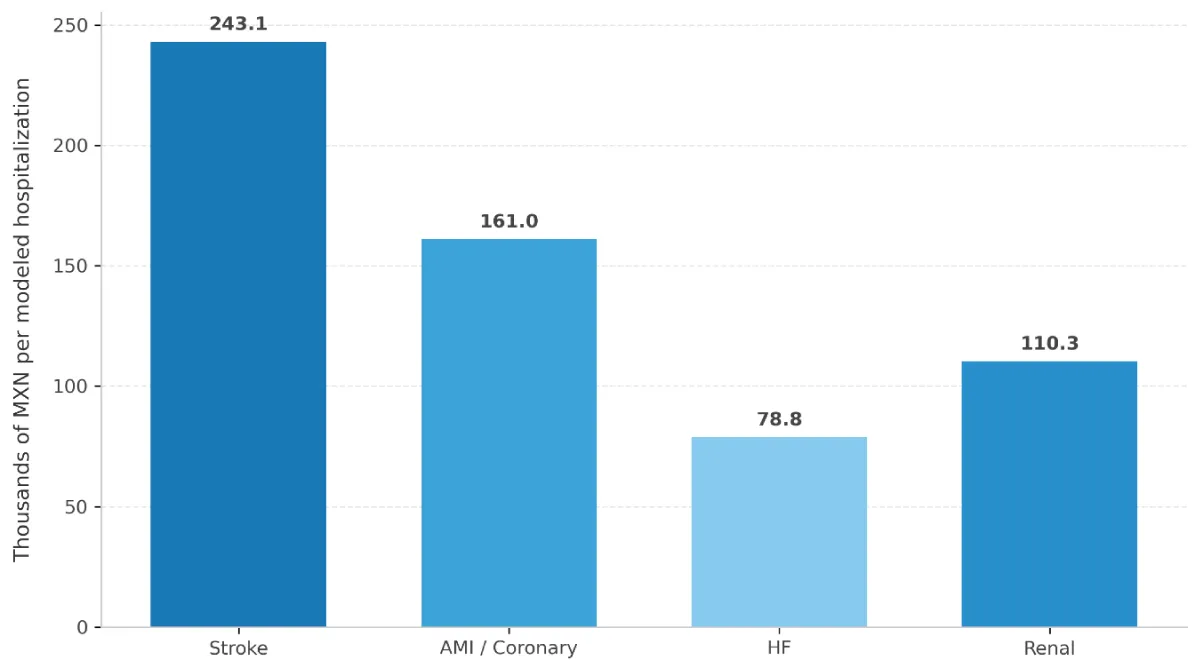
Figure 2: Modeled hospitalization costs associated with major complications. The figure illustrates the cost gradient between conventional ward hospitalization and severe complications requiring intensive care.
Estimated annual complication rates
Because Mexico lacks a nationally representative longitudinal RH registry providing annual hospitalization incidence by complication, event rates were treated as model assumptions, not observed epidemiological data.
The base-case scenario assumed:
| Complication | Annual hospitalization probability |
| Stroke | 0.8% |
| Acute MI/coronary event | 0.6% |
| Heart failure | 1.0% |
| Major renal complication | 0.6% |
| Composite | 3.0% |
These event probabilities were retained as scenario inputs because Mexico lacks a national longitudinal RH cohort with adjudicated event incidence. They were selected to remain below the total cardiovascular event burden reported in RH cohorts and are now used only to define the total event burden occurring among RH patients [23-30]. The portion attributed specifically to RH is calculated separately by subtracting the counterfactual non-resistant-hypertension risk using adjusted comparative hazard ratios [27].
The model should therefore be interpreted as a scenario-based planning analysis rather than a national surveillance estimate. The distinction between total RH-associated events and the incremental RH-attributable excess is maintained throughout the revised Results.
Annual hospitalization cost per patient with resistant hypertension
The annual expected cost was calculated as:
where Pi represents the annual probability of hospitalization for complication i, and Ci represents the modeled cost of that hospitalization.
The results were:
- stroke: 0.008 × $243,136 = $1,945
- acute MI: 0.006 × $160,978 = $966
- heart failure: 0.010 × $78,820 = $788
- renal complication: 0.006 × $110,348 = $662
Total: MXN$4,361 per patient with true RH per year (total hospitalization burden occurring among RH patients).
This MXN$4,361 value is an associated, not fully attributable, burden. Applying the event-specific comparative hazard ratios yields a counterfactual non-RH hospitalization cost of approximately MXN$3,526 per patient-year and an incremental RH-attributable excess of approximately MXN$835 per patient-year. The attributable excess is composed of approximately MXN$239 for stroke, MXN$187 for ischemic coronary events, MXN$248 for heart failure, and MXN$161 for major renal complications.
National direct hospitalization burden
Applying MXN$4,361 per patient-year to approximately 1.29 million patients with true RH yields a total hospitalization burden occurring among the RH population of approximately MXN$5.62 billion/year.
MXN$5.62 billion/year (total RH-associated hospitalization burden).
For approximately 1.84 million patients with aTRH, the analogous total associated hospitalization burden is approximately MXN$8.0 billion/year; however, this aTRH figure is not used as the primary estimate of causal RH-attributable cost because pseudoresistance may be present.
MXN$8.0 billion/year (aTRH-associated scenario)
The estimated range is therefore:
| Population | Estimated patients | Total associated hospitalization burden | Incremental RH-attributable burden |
| True RH | 1.29 million | MXN$5.62 billion/year | MXN$1.08 billion/year |
| aTRH | 1.84 million | MXN$8.0 billion/year | Not used as primary causal estimate |
| High scenario | 2.50 million | MXN$10.9 billion/year | Scenario only; no causal attribution |
The central economic finding of the revised model is therefore two-dimensional: approximately MXN$5.62 billion/year represents hospitalization costs occurring among patients with true RH, whereas approximately MXN$1.08 billion/year represents the incremental direct hospitalization cost attributable specifically to treatment resistance after subtraction of the non-resistant-hypertension counterfactual.
Direct cost by complication
The contribution of each complication to the annual direct burden among true RH patients is approximately:
| Complication | Total RH-associated annual national cost | Incremental RH-attributable annual cost |
| Stroke | MXN$2.51 billion | MXN$0.31 billion |
| Acute MI/coronary events | MXN$1.25 billion | MXN$0.24 billion |
| Heart failure | MXN$1.02 billion | MXN$0.32 billion |
| Renal complications | MXN$0.85 billion | MXN$0.21 billion |
| Total | MXN$5.62 billion | MXN$1.08 billion |
In the total RH-associated model, cerebrovascular disease remains the largest hospitalization component. In the attributable-risk model, the excess national annual costs are approximately MXN$0.31 billion for stroke, MXN$0.24 billion for ischemic coronary events, MXN$0.32 billion for heart failure, and MXN$0.21 billion for renal complications, totaling approximately MXN$1.08 billion/year.
This distribution is clinically coherent with the well-established vascular, cardiac and renal phenotype of resistant hypertension [23-30].
Indirect economic burden
Direct hospital expenditure captures only a fraction of the economic consequences of RH.
The Mexican literature demonstrates that hypertension generates substantial productivity losses. Arredondo and colleagues estimated that approximately 53% of the overall economic burden of hypertension in Mexico was attributable to indirect costs [12,13].
Stevens, et al. subsequently demonstrated that productivity losses represented a very large component of the economic burden of hypertension and other cardiovascular conditions in Mexico [14].
Indirect costs include:
- premature mortality;
- permanent disability;
- temporary disability;
- absenteeism;
- presenteeism;
- informal caregiving;
- transportation;
- loss of household productivity;
- rehabilitation-related losses;
- early retirement.
For this analysis, two Mexican historical cost structures were used as sensitivity boundaries:
Conservative indirect-cost structure:
Indirect costs = 53% of total cost.
If the RH-attributable direct component is MXN$1.08 billion:
Total societal cost ≈ MXN$2.29 billion/year
and
Indirect cost ≈ MXN$1.22 billion/year.
Higher indirect-cost structure:
Using the 76% productivity-loss proportion reported in the Mexican cardiovascular cost analysis:
Total societal envelope ≈ MXN$4.49 billion/year
and
Indirect component ≈ MXN$3.41 billion/year.
These figures should not be interpreted as a definitive national estimate of the societal cost of resistant hypertension. Rather, they provide an economically plausible envelope based on Mexican hypertension cost structures.
Five-year projection
A dynamic open-cohort projection was developed in which annual population exposure is first indexed to CONAPO demographic projections and mortality is treated as a competing-risk/exposure-time correction [20]. The 2%, 3%, and 4% rates are retained only as sensitivity scenarios for secular change in event intensity and resource use after demographic scaling.
For the prespecified 3% sensitivity scenario applied to the RH-attributable direct-cost component:
With an annual baseline RH-attributable direct cost of approximately MXN$1.08 billion:
| Sensitivity growth in event intensity/resource use | 5-year cumulative RH-attributable direct cost |
| 2% | MXN$5.60 billion |
| 3% | MXN$5.72 billion |
| 4% | MXN$5.83 billion |
Across the 2%–4% sensitivity range, the 5-year cumulative RH-attributable direct cost is approximately MXN$5.60–5.83 billion. These values are sensitivity envelopes rather than observed expenditure forecasts.
Twenty-year projection (Figure 3)
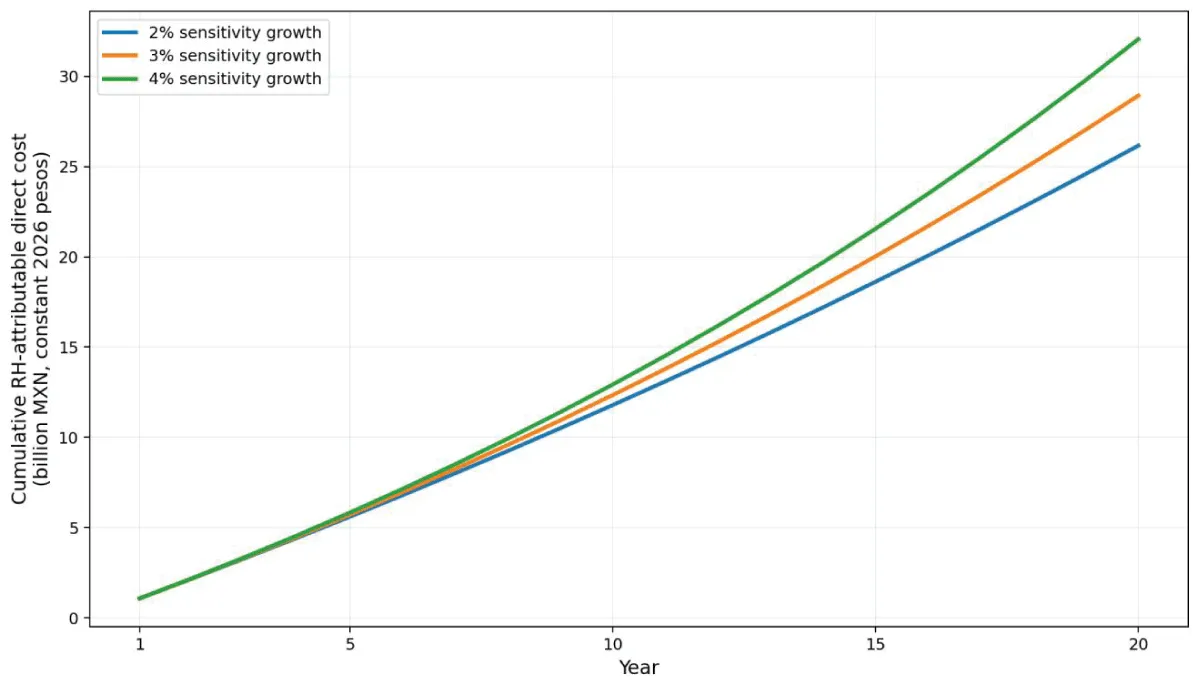
Figure 3: Twenty-year projected RH-attributable direct hospitalization burden. Cumulative incremental costs attributable specifically to resistant hypertension are shown under 2%, 3%, and 4% event-intensity/resource-use sensitivity scenarios. These rates are not interpreted as demographic population growth. The demographic component is parameterized separately using official CONAPO population projections, with mortality treated as a competing-risk/exposure-time adjustment.
The 20-year horizon magnifies uncertainty in event intensity, resource use, demographic exposure, and competing mortality; therefore, results are reported as scenario envelopes rather than as a single deterministic forecast.
| Sensitivity growth in event intensity/resource use | 20-year cumulative RH-attributable direct cost |
| 2% | MXN$26.2 billion |
| 3% | MXN$28.9 billion |
| 4% | MXN$32.1 billion |
Under the 3% sensitivity scenario:
The cumulative 20-year RH-attributable direct hospitalization burden is approximately MXN$28.9 billion under the 3% sensitivity scenario; the corresponding 2% and 4% scenarios are approximately MXN$26.2 and MXN$32.1 billion, respectively.
All projections are expressed in constant 2026 pesos. They should not be interpreted as nominal future budgets or as empirically observed growth trajectories. Their purpose is to quantify the order of magnitude and uncertainty of RH-attributable resource use under transparent demographic and epidemiologic assumptions.
Discounted economic projection
For health-economic decision making, future costs were also discounted at 5% annually, consistent with conventional Mexican pharmacoeconomic practice and international economic-evaluation methodology [15-18].
At 3% annual event growth:
Five-year discounted RH-attributable direct cost ≈ MXN$4.94 billion
Twenty-year discounted RH-attributable direct cost ≈ MXN$17.19 billion
Thus:
| Horizon | Undiscounted RH-attributable cost | Discounted 5% |
| 5 years | MXN$5.72 B | MXN$4.94 B |
| 20 years | MXN$28.9 B | MXN$17.19 B |
The discounted figure is useful for economic comparison, whereas the undiscounted estimate communicates cumulative resource use. Because this is a cost-of-illness planning model rather than a cost-effectiveness analysis of a specific intervention, both are presented and the assumptions are explicitly separated from observed data.
Societal projection
If the conservative Mexican historical indirect-cost structure is applied to the hospitalization burden, the total societal economic envelope would be approximately:
Five years ≈ MXN$12.2 billion (conservative 53% indirect-cost structure; 3% sensitivity scenario).
Twenty years ≈ MXN$61.6 billion (conservative 53% indirect-cost structure; 3% sensitivity scenario)
Using the higher productivity-loss scenario produces approximately:
Five years ≈ MXN$23.8 billion (higher 76% indirect-cost structure; 3% sensitivity scenario)
Twenty years ≈ MXN$120.5 billion (higher 76% indirect-cost structure; 3% sensitivity scenario)
These societal projections remain secondary sensitivity analyses because the indirect-cost shares were derived from hypertension and cardiovascular disease broadly rather than from RH-specific Mexican cohorts. The revised manuscript therefore treats the incremental direct hospitalization burden as the primary economic estimate and the societal envelope as exploratory.
Economic value of better control
The most important implication of the model is not the absolute cost; it is the potentially avoidable component.
If an intervention strategy reduced complication-related hospitalization by:
| Reduction in RH-attributable hospitalization | Annual direct savings |
| 10% | ≈ MXN$108 million |
| 20% | ≈ MXN$215 million |
| 30% | ≈ MXN$323 million |
At 20 years, using the discounted 3% sensitivity-scenario RH-attributable direct cost of approximately MXN$17.19 billion:
- 10% reduction → ≈ MXN$1.72 billion present-value savings
- 20% reduction → ≈ MXN$3.44 billion
- 30% reduction → ≈ MXN$5.16 billion
These are budget-impact scenarios, not claims that any particular intervention will necessarily achieve these reductions.
Nevertheless, the biological rationale is compelling. Individual-participant meta-analysis has demonstrated that pharmacological blood-pressure lowering reduces major cardiovascular events across a broad range of baseline blood pressure levels [33,34].
Therapeutic implications
The economic model reinforces a central clinical principle: the most expensive patient with hypertension is often not the patient receiving an additional antihypertensive drug, but the patient who progresses to stroke, heart failure, myocardial infarction or advanced kidney disease.
Current treatment strategies emphasize optimized triple therapy.
The 2024 ESC guideline recommends a combination of:
RAS blocker + calcium-channel blocker + thiazide/thiazide-like diuretic
before labeling hypertension resistant [3].
The 2026 Mexican Consensus similarly recommends:
ACE inhibitor/ARB + CCB + chlorthalidone or indapamide
with fixed-dose combinations preferred [8].
If resistance persists, spironolactone is the preferred fourth-line treatment [5,8,35]. The PATHWAY-2 trial established the superiority of spironolactone over bisoprolol and doxazosin in resistant hypertension [35].
A network meta-analysis also found spironolactone to be the most effective pharmacological intervention for reducing office and ambulatory systolic blood pressure among evaluated strategies [36].
Recent literature has expanded therapeutic options further, including aldosterone-targeted strategies, endothelin antagonists and interventional therapies [37-39].
For example, aprocitentan has recently been evaluated in patients with chronic kidney disease and resistant hypertension, while aldosterone synthase inhibitors are emerging as an important therapeutic class [37,38].
Renal denervation has also re-emerged as a potential adjunctive strategy for selected patients with uncontrolled resistant hypertension [39-42]. Contemporary consensus documents emphasize that it should be considered only after careful confirmation of true resistance and optimized medical treatment [39-42].
The Mexican opportunity: from uncontrolled hypertension to precision hypertension care
The current Mexican situation suggests a critical opportunity.
Approximately 5 million treated adults remain uncontrolled in the epidemiological model.
The majority of these individuals should not automatically be classified as resistant.
Instead, they represent a population requiring systematic evaluation:
Uncontrolled BP → Confirm measurement → HBPM/ABPM → Assess adherence → Review interfering medications → Optimize combination therapy → Evaluate obesity, sodium excess and OSA Search for secondary hypertension → Confirm true RH → Triple therapy optimized → MRA/spironolactone → Specialized hypertension clinic → Consider advanced interventions in selected patients
This pathway is consistent with the 2026 Mexican Consensus and contemporary international guidelines [8-11].
Resistant hypertension within the cardio-reno-metabolic phenotype
An important conceptual advance is that RH should not be considered exclusively a blood-pressure disorder.
The Mexican MACARENHA framework emphasizes the interaction between:
- metabolic dysfunction;
- visceral adiposity;
- cardiovascular disease;
- arterial stiffness;
- renal dysfunction;
- respiratory disease/OSA;
- neurological complications;
- hepatic/metabolic disease [8].
This is particularly relevant because obesity, diabetes, CKD and sleep apnea are disproportionately represented in resistant hypertension [5,23,24].
Consequently, the economic burden of RH may be underestimated if the analysis focuses solely on antihypertensive drug expenditure.
A patient with resistant hypertension, obesity, diabetes, CKD and heart failure is simultaneously consuming resources across multiple therapeutic domains.
This supports the use of a cardio-reno-metabolic disease-management model, rather than an isolated hypertension clinic model.
Limitations
This model has several important limitations that should be considered when interpreting both the cross-sectional burden and the 20-year projections.
First, Mexico does not yet have a nationally representative registry of true RH confirmed with ABPM/HBPM and objective adherence assessment. The 10.3% true-RH prevalence is therefore extrapolated from international evidence, which may introduce transportability bias if Mexican treatment patterns, adherence, comorbidity, access to care, or referral intensity differ from the contributing cohorts [22].
Second, the annual hospitalization probabilities for stroke, myocardial infarction, heart failure, and renal complications are scenario inputs rather than observed Mexican RH incidence rates. This can bias absolute cost estimates in either direction. The revised analysis reduces causal over-attribution by subtracting the counterfactual non-RH risk, but the resulting estimate remains dependent on the validity and transportability of adjusted hazard ratios from comparative cohorts [27].
Third, official IMSS unit costs are institution-specific economic inputs and may not represent costs in ISSSTE, Secretaría de Salud, private institutions, or other Mexican care settings [32]. Consequently, national extrapolation may overestimate or underestimate true system-wide resource use depending on payer mix, case severity, and regional practice.
Fourth, indirect-cost estimates are extrapolated from historical Mexican studies of hypertension and cardiovascular disease rather than measured in RH-specific populations [12-14]. This creates structural uncertainty and is why indirect costs are reported only as sensitivity envelopes.
Fifth, the attributable-risk calculation assumes that adjusted hazard ratios from observational comparative cohorts can be applied to the modeled annual event probabilities. Although this is preferable to assigning the full event burden to RH, residual confounding and differences in definitions of controlled, uncontrolled, apparent-resistant, and confirmed resistant hypertension may persist [27,28,30].
Sixth, the 20-year projection necessarily extrapolates beyond directly observed Mexican RH data. Demographic projections improve realism by allowing the exposed adult population to evolve over time, and mortality is treated as a competing risk, but future changes in hypertension prevalence, obesity, diabetes, chronic kidney disease, treatment uptake, medication adherence, technology, and healthcare prices are uncertain. Long-horizon economic models are especially sensitive to structural assumptions and extrapolation choices; this is why the revised analysis reports explicit scenario ranges and separates demographic drivers from the 2%–4% event-intensity sensitivity parameter [16,43].
Seventh, national all-cause and cardiovascular mortality statistics are population-level inputs rather than RH-specific mortality rates. Cardiovascular mortality is nested within all-cause mortality and is therefore not added independently; doing so would double count deaths. This treatment is conservative but cannot reproduce age-, sex-, and comorbidity-specific competing risks without individual-level Mexican data [20,21,29].
Finally, this is a prevalence-based cost-of-illness and planning model, not a causal microsimulation or a cost-effectiveness analysis of a specific intervention. The estimates quantify plausible burden under stated assumptions; they do not demonstrate that all modeled costs are preventable or that any specific therapeutic strategy will generate the projected savings [15-18].
Accordingly, the appropriate interpretation is not:
“Mexico spends exactly MXN$5.6 billion annually because of resistant hypertension.”
A more defensible interpretation is:
Under the stated epidemiological and hospitalization assumptions, approximately MXN$5.6 billion in annual hospitalization costs occur among patients modeled as having true RH; after subtracting the expected non-resistant-hypertension counterfactual, approximately MXN$1.08 billion/year is the incremental direct hospitalization burden attributable specifically to RH.
This distinction between associated burden and incremental attributable burden is central to the revised interpretation.
Strengths
This model has several strengths.
First, it incorporates the most recent Mexican hypertension prevalence data [7].
Second, it incorporates the 2026 Mexican hypertension consensus, rather than relying exclusively on foreign guidelines [8].
Third, it uses official 2026 IMSS unit costs, avoiding the common problem of converting outdated US or European hospitalization costs into Mexican pesos [32].
Fourth, it distinguishes difficult-to-control hypertension, apparent treatment-resistant hypertension and true resistant hypertension.
Fifth, it separates direct hospital costs from indirect societal costs.
Sixth, it provides both 5-year and 20-year projections, allowing policymakers to visualize the consequences of delayed intervention.
Finally, it provides a framework that can be converted into a prospective Mexican registry and subsequently replaced with observed Mexican event rates.
Resistant hypertension represents one of the most clinically complex and economically consequential phenotypes of hypertension.
In Mexico, the latest ENSANUT data indicate that approximately 24 million adults have hypertension, of whom nearly 5 million remain uncontrolled despite treatment [7]. From this population, a modeled 1.84 million individuals may have apparent treatment-resistant hypertension and approximately 1.29 million may have true resistant hypertension.
Using conservative complication assumptions and official 2026 IMSS costs, the total direct hospitalization burden occurring among patients with true RH is approximately:
MXN$5.6 billion per year (associated burden among true RH patients) whereas the corresponding associated burden for apparent treatment-resistant hypertension may approach:
MXN$8.0 billion per year (aTRH scenario).
After subtraction of the modeled non-resistant-hypertension counterfactual, the incremental direct hospitalization burden attributable specifically to true RH is approximately MXN$1.08 billion per year. Under the 3% event-intensity/resource-use sensitivity scenario, this attributable burden accumulates to approximately:
MXN$5.72 billion over 5 years and MXN$28.9 billion over 20 years before discounting; the corresponding 20-year 2%–4% sensitivity range is approximately MXN$26.2–32.1 billion.
When indirect productivity-related costs are incorporated using historical Mexican cost structures, the societal burden remains substantial but is more uncertain; these values are therefore treated as secondary sensitivity envelopes rather than primary RH-attributable estimates.
The principal implication is therefore not merely that RH is associated with high resource use. The revised counterfactual analysis indicates that a measurable component of this burden is incremental to the risk expected in non-resistant hypertension, while also making clear that most events in RH patients cannot automatically be attributed to drug resistance itself.
The appropriate response is not indiscriminate escalation of medication. It is precision diagnosis, exclusion of pseudoresistance, confirmation with out-of-office blood-pressure monitoring, adherence assessment, early optimization of combination therapy, systematic detection of secondary hypertension and aggressive management of the cardio-reno-metabolic phenotype.
A prospective Mexican registry is therefore urgently justified. Its purpose should be to replace the present model-based estimates with real-world Mexican incidence, hospitalization, disability, mortality and cost data.
- Zhou B, Perel P, Mensah GA, Ezzati M. Global epidemiology, health burden and effective interventions for elevated blood pressure and hypertension. Nat Rev Cardiol. 2021;18(11):785-802. Available from: https://dx.doi.org/10.1038/s41569-021-00559-8.
- Mancia G, Kreutz R, Brunström M, Burnier M, Grassi G, Januszewicz A, et al. 2023 ESH Guidelines for the management of arterial hypertension. J Hypertens. 2023;41(12):1874-2071. Available from: https://dx.doi.org/10.1097/HJH.0000000000003480.
- McEvoy JW, McCarthy CP, Bruno RM, Brouwers S, Canavan MD, Ceconi C, et al. 2024 ESC Guidelines for the management of elevated blood pressure and hypertension. Eur Heart J. 2024;45(38):3912-4018. Available from: https://dx.doi.org/10.1093/eurheartj/ehae178
- Kreutz R, Brunström M, Burnier M, Grassi G, Januszewicz A, Muiesan ML, et al. 2024 European Society of Hypertension clinical practice guidelines for the management of arterial hypertension. Eur J Intern Med. 2024;126:1-15. Available from: https://dx.doi.org/10.1016/j.ejim.2024.05.033.
- Jones DW, Ferdinand KC, Taler SJ, Johnson HM, Shimbo D, Abdalla M, et al. 2025 AHA/ACC/AANP/AAPA/ABC/ACCP/ACPM/AGS/AMA/ASPC/NMA/PCNA/SGIM guideline for the prevention, detection, evaluation, and management of high blood pressure in adults. J Am Coll Cardiol. 2025;86(18):1567-1678. Available from: https://dx.doi.org/10.1016/j.jacc.2025.05.007.
- World Health Organization. Global report on hypertension 2025: high stakes—turning evidence into action. Geneva: World Health Organization; 2025. ISBN 978-92-4-011556-9.
- Campos-Nonato I, Monterrubio-Flores E, Ramírez-Villalobos D, Arias-Mendoza MA, Gómez-Álvarez E, Alcocer-Díaz-Barreiro L, et al. Hipertensión arterial en adultos y brechas de atención a nivel nacional y estatal, Ensanut 2021-2024. Salud Publica Mex. 2025;67(6):633-643. Available from: https://dx.doi.org/10.21149/17102.
- Abdo-Francis M, Alcocer L, Alcocer-Chauvet A, Almeida-Gutiérrez E, Altamirano-Cardoso E, Álvarez-López H, et al. The 2026 Mexican Consensus on Arterial Hypertension: Expert Group on Arterial Hypertension (GREHTA). Cardiovasc Metab Sci. 2026;37(1). Available from: https://dx.doi.org/10.35366/.
- Carey RM, Calhoun DA, Bakris GL, Brook RD, Daugherty SL, Dennison-Himmelfarb CR, et al. Resistant hypertension: detection, evaluation, and management: a scientific statement from the American Heart Association. Hypertension. 2018;72(5):e53-e90. Available from: https://dx.doi.org/10.1161/HYP.0000000000000084.
- Schiffrin EL, Fisher NDL. Diagnosis and management of resistant hypertension. BMJ. 2024;385:e079108. Available from: https://dx.doi.org/10.1136/bmj-2023-079108.
- Cluett JL, William JH. Evaluation and Management of Resistant Hypertension: Core Curriculum 2024. Am J Kidney Dis. 2024;84(3):374-387. Available from: https://dx.doi.org/10.1053/j.ajkd.2024.04.009.
- Arredondo A, Zúñiga A. Epidemiological changes and financial consequences of hypertension in Latin America: implications for the health system and patients in Mexico. Cad Saude Publica. 2012;28(3):497-502. Available from: https://dx.doi.org/10.1590/S0102-311X2012000300010.
- Arredondo A, Cuadra SM, Duarte MB. Challenges of the epidemiological and economic burdens associated with hypertension in middle income countries: evidence from Mexico. BMC Public Health. 2015;15:1106. Available from: https://dx.doi.org/10.1186/s12889-015-2430-x.
- Stevens B, Pezzullo L, Verdian L, Tomlinson J, Estrada-Aguilar C, George A, et al. The economic burden of hypertension, heart failure, myocardial infarction, and atrial fibrillation in Mexico. Arch Cardiol Mex. 2018;88(3):241-244. Available from: https://dx.doi.org/10.1016/j.acmx.2018.03.004.
- Sanders GD, Neumann PJ, Basu A, Brock DW, Feeny D, Krahn M, et al. Recommendations for conduct, methodological practices, and reporting of cost-effectiveness analyses: Second Panel on Cost-Effectiveness in Health and Medicine. JAMA. 2016;316(10):1093-1103. Available from: https://doi.org/10.1001/jama.2016.12195
- Husereau D, Drummond M, Augustovski F, de Bekker-Grob E, Briggs AH, Carswell C, et al. Consolidated Health Economic Evaluation Reporting Standards 2022 (CHEERS 2022) statement. Value Health. 2022;25(1):3-9. Available from: https://dx.doi.org/10.1016/j.jval.2021.11.1351.
- Drummond MF, Sculpher MJ, Claxton K, Stoddart GL, Torrance GW. Methods for the economic evaluation of health care programmes. 4th ed. Oxford: Oxford University Press; 2015.
- Consejo de Salubridad General. Guía para la conducción de estudios de evaluación económica para la actualización del Compendio Nacional de Insumos para la Salud. Ciudad de México: Consejo de Salubridad General; 2017.
- Palomo-Piñón S, Antonio-Villa NE, García-Cortés LR, et al. Patients living with arterial hypertension in Mexico: first insights of the Mexican Registry of Arterial Hypertension (RIHTA Study). Am J Hypertens. 2024;37(7):503-513. Available from: https://dx.doi.org/10.1093/ajh/hpae024.
- Secretaría General del Consejo Nacional de Población. Proyecciones de la población de México y de las Entidades Federativas 2020–2070. Ciudad de México: SGCONAPO; 2024. Available from: https://www.gob.mx/conapo/acciones-y-programas/conciliacion-demografica-de-1950-a-2019-y-proyecciones-de-la-poblacion-de-mexico-y-de-las-entidades-federativas-2020-a-2070
- Instituto Nacional de Estadística y Geografía. Estadísticas de Defunciones Registradas 2024. Ciudad de México: INEGI; 2025. Reporte de resultados 26/25.
- Noubiap JJ, Nansseu JR, Nyaga UF, Sime PS, Francis I, Bigna JJ. Global prevalence of resistant hypertension: a meta-analysis of data from 3.2 million patients. Heart. 2019;105(2):98-105. Available from: https://dx.doi.org/10.1136/heartjnl-2018-313599.
- Haber A, Foy A. Resistant Hypertension: A Brief Review of Pathophysiology. J Gen Intern Med. 2025;40(3):654-658. Available from: https://dx.doi.org/10.1007/s11606-024-09103-z.
- Lauder L, Mahfoud F, Böhm M. Management of Resistant Hypertension. Annu Rev Med. 2024;75:443-457. Available from: https://dx.doi.org/10.1146/annurev-med-050922-052605.
- Schmieder RE. 2025 Update on resistant hypertension in CKD: where do we stand and where do we go? Clin Kidney J. 2025;18(Suppl 2):ii10-ii16. Available from: https://dx.doi.org/10.1093/ckj/sfaf285.
- Daugherty SL, Powers JD, Magid DJ, Tavel HM, Masoudi FA, Margolis KL, et al. Incidence and prognosis of resistant hypertension in hypertensive patients. Circulation. 2012;125(13):1635-1642. Available from: https://dx.doi.org/10.1161/CIRCULATIONAHA.111.068064.
- Sim JJ, Bhandari SK, Shi J, Reynolds K, Calhoun DA, Kalantar-Zadeh K, et al. Comparative risk of renal, cardiovascular, and mortality outcomes in controlled, uncontrolled resistant, and nonresistant hypertension. Kidney Int. 2015;88(3):622-632. Available from: https://dx.doi.org/10.1038/ki.2015.142.
- Bangalore S, Davis BR, Cushman WC, Pressel SL, Muntner P, et al. Treatment resistant hypertension and outcomes based on randomized treatment group in ALLHAT. Am J Med. 2017;130(4):439-448.e9. Available from: https://dx.doi.org/10.1016/j.amjmed.2016.10.002.
- PubMedde la Sierra A, Ruilope LM, Staplin N, Gorostidi M, Vinyoles E, Segura J, et al. Resistant hypertension and mortality: an observational cohort study. Hypertension. 2024;81(11):2350-2356. Available from: https://dx.doi.org/10.1161/HYPERTENSIONAHA.124.23276.
- PubMedTeza H, Anothaisintawee T, Limpijankit T, Tansawet A, Boonmanunt S, Pattanateepapon A, et al. Incidence and prognosis of apparent-treatment resistant hypertension: a multi-state analysis using real world evidence. Clin Hypertens. 2026;32:e5. Available from: https://dx.doi.org/10.5646/ch.2026.32.e5.
- McCormack T, Ben Dor NR, Norris T, Giannoula A, Coto E, Rhodes KM, et al. Uncontrolled hypertension prevalence, characteristic profiles, and risk of cardiorenal and metabolic outcomes: insights from the EnligHTN study. Adv Ther. 2026. Available from: https://dx.doi.org/10.1007/s12325-026-03681-6.
- Instituto Mexicano del Seguro Social. Acuerdo ACDO.AS3.HCT.251125/344.P.DF por el que se aprueban los Costos Unitarios por Nivel de Atención Médica actualizados al año 2026. Diario Oficial de la Federación. 2025 Dec 10. (IMSS)
- Blood Pressure Lowering Treatment Trialists' Collaboration. Pharmacological blood pressure lowering for primary and secondary prevention of cardiovascular disease across different levels of blood pressure: an individual participant-level data meta-analysis. Lancet. 2021;397(10285):1625-1636. Available from: https://dx.doi.org/10.1016/S0140-6736(21)00590-0.
- Blood Pressure Lowering Treatment Trialists' Collaboration. Age-stratified and blood-pressure-stratified effects of blood-pressure-lowering pharmacotherapy for the prevention of cardiovascular disease and death: an individual participant-level data meta-analysis. Lancet. 2021;398(10305):1053-1064. Available from: https://dx.doi.org/10.1016/S0140-6736(21)01921-8.
- Williams B, MacDonald TM, Morant S, Webb DJ, Sever P, McInnes G, et al. Spironolactone versus placebo, bisoprolol, and doxazosin to determine the optimal treatment for drug-resistant hypertension (PATHWAY-2). Lancet. 2015;386(10008):2059-2068. Available from: https://dx.doi.org/10.1016/S0140-6736(15)00257-3.
- Tian Z, Barbosa CV, Lang H, Bauersachs J, Melk A, Schmidt BMW. Efficacy of pharmacological and interventional treatment for resistant hypertension: a network meta-analysis. Cardiovasc Res. 2024 Feb 27;120(1):108-119. Available from: https://doi.org/10.1093/cvr/cvad165
- Rossignol P, Clozel M, Dreier RF, Flack JM, Flamion B, Mann J, et al. Aprocitentan in patients with chronic kidney disease and resistant hypertension. Hypertension. 2026;83(2):e255-e263. Available from: https://dx.doi.org/10.1161/HYPERTENSIONAHA.125.25563.
- Kobayashi M, Pitt B, Ferreira JP, Rossignol P, Girerd N, Zannad F. Aldosterone-targeted therapies: early implementation in resistant hypertension and chronic kidney disease. Eur Heart J. 2025;46(27):2618-2642. Available from: https://dx.doi.org/10.1093/eurheartj/ehaf225.
- Cluett JL, Blazek O, Brown AL, East C, Ferdinand KC, Fisher NDL, et al. Renal denervation for the treatment of hypertension: a scientific statement from the American Heart Association. Hypertension. 2024;81(10):e135-e148. Available from: https://dx.doi.org/10.1161/HYP.0000000000000240.
- Azizi M, Schmieder RE, Mahfoud F, Weber MA, Lobo MD, Sharp ASP, et al. Endovascular ultrasound renal denervation to treat hypertension resistant to a triple medication pill (RADIANCE-HTN TRIO). Lancet. 2021;397(10293):2476-2486. Available from: https://dx.doi.org/10.1016/S0140-6736(21)00788-1.
- Kandzari DE, Böhm M, Mahfoud F, Townsend RR, Weber MA, Pocock S, et al. Effect of renal denervation on blood pressure in the presence of antihypertensive drugs: 6-month efficacy and safety results from the SPYRAL HTN-ON MED proof-of-concept randomised trial. Lancet. 2018;391(10137):2346-2355. Available from: https://dx.doi.org/10.1016/S0140-6736(18)30951-6.
- Kario K, Kai H, Rakugi H, Hoshide S, Node K, Maekawa Y, et al. Consensus statement on renal denervation by the Joint Committee of Japanese Society of Hypertension, Japanese Association of Cardiovascular Intervention and Therapeutics, and the Japanese Circulation Society. Hypertens Res. 2024;47(10):2624-2632. Available from: https://dx.doi.org/10.1038/s41440-024-01700-z.
- Roze S, Bertrand N, Eberst L, Borget I. Projecting overall survival in health-economic models: uncertainty and maturity of data. Curr Med Res Opin. 2023;39(3):367-374. Available from: https://dx.doi.org/10.1080/03007995.2023.2167442.